
The Four Pillars Every Child Needs to Thrive
For many years, success in education was measured by one simple question:
"How much does this child know?"
Today, I believe we should be asking a different question:
"Who is this child becoming?"
Knowledge is important. Reading, mathematics, science, and technology all have their place. But as parents and educators, we know that life demands much more than academic achievement.
Every day our children are required to make decisions, manage emotions, solve problems, work with others, and adapt to change.
These are not examination skills. They are life skills.
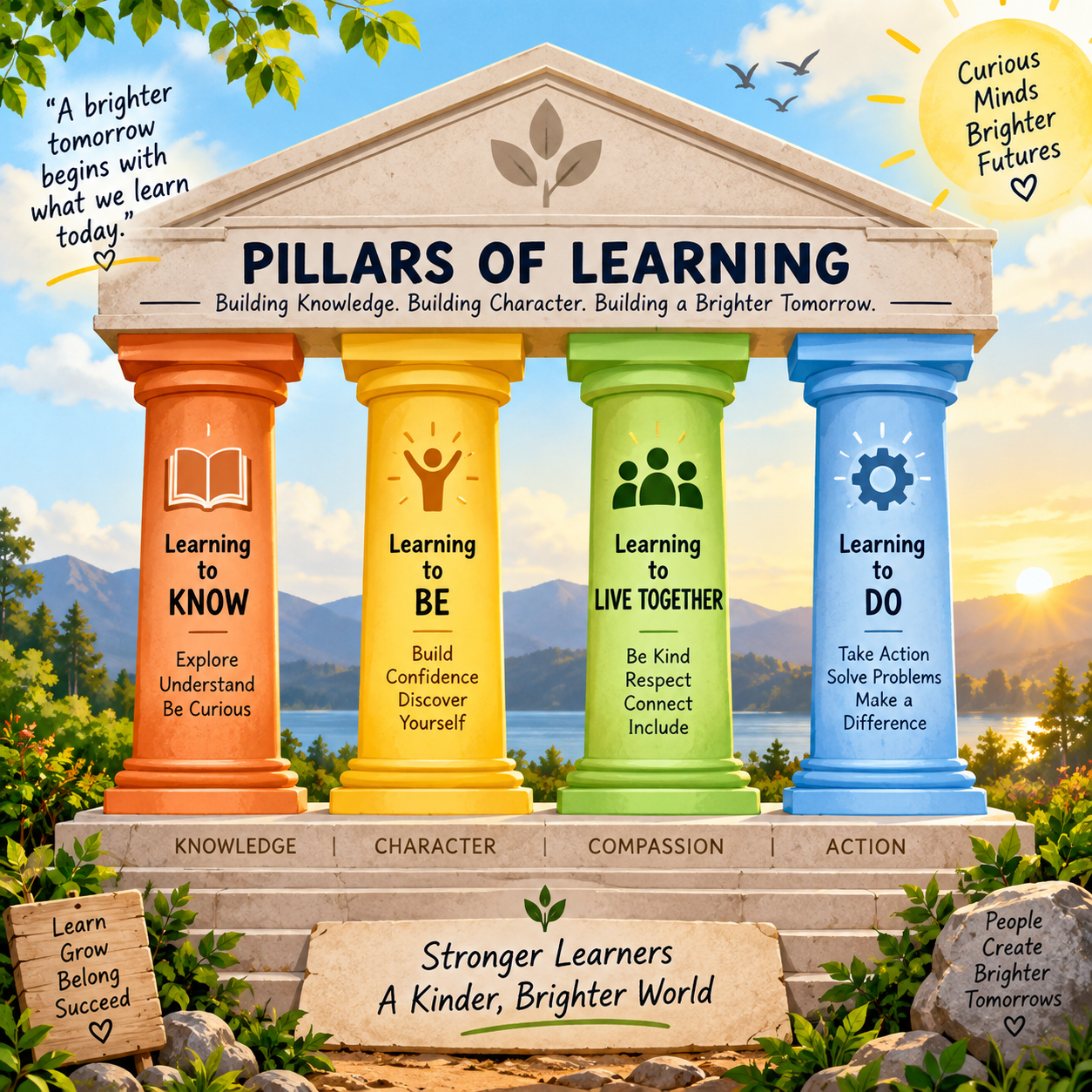
UNESCO identified four pillars of learning that remain just as relevant today as when they were first introduced. They provide a framework for educating the whole child rather than simply filling young minds with information.
1. Learn to Know
Children are naturally curious. They ask endless questions. Why is the sky blue? Why do birds fly? Why do people feel sad?
Unfortunately, somewhere along the way, many children stop asking "why" and start asking, "Will this be in the test?"
Learning to Know is about keeping curiosity alive. It is about encouraging children to explore, investigate, question, and discover rather than simply memorise facts. Curiosity is the engine of lifelong learning.
2. Learn to Do
Knowledge becomes meaningful only when it is applied. Children need opportunities to make decisions, solve problems, create solutions, and learn from mistakes.
Confidence is not built by always getting the right answer. It is built by trying, failing, adapting, and trying again.
Learning to Do develops resilience and independence—qualities that will serve children long after they leave the classroom.
3. Learn to Live Together
Perhaps no skill is more important in today's connected world. Children need to understand that every person has different thoughts, feelings, strengths, and experiences.
Empathy, communication, respect, cooperation, and conflict resolution are not optional extras. They are essential life skills.
When children learn to listen before judging and collaborate instead of competing, they become better classmates, better friends, and eventually better leaders.
4. Learn to Be
This may be the most important pillar of all.
Learning to Be is about discovering identity, developing self-awareness, building confidence, and understanding emotions. It is about helping children recognise that mistakes are opportunities to grow, challenges are opportunities to become stronger, and every experience contributes to the person they are becoming.
A child who knows who they are is far better equipped to navigate an uncertain world.
More Than Academic Success
As a retired teacher with more than forty years of experience, I have come to believe that these four pillars are not simply educational ideals.
They are the foundation of emotional intelligence.
They help children become curious thinkers, confident problem-solvers, compassionate friends, and resilient individuals.
That is the vision behind Survive. Discover. Grow. – The Island Adventure.
Through the adventures of five young friends stranded on a remote island, children experience these four pillars in action. They learn to ask questions, solve problems, work together, and discover strengths they never knew they possessed.
Because education is not only about preparing children for the next examination. It is about preparing them for the next challenge, the next relationship, the next disappointment, the next opportunity, and ultimately, for life itself.
Over the next four articles, I will explore each of these pillars in greater depth and share practical ways that parents, teachers, and schools can nurture emotional intelligence every day.
Because when we help children Learn to Know, Learn to Do, Learn to Live Together, and Learn to Be, we are giving them something far more valuable than good marks. We are giving them the skills to thrive.
Continue the Journey
SURVIVE. DISCOVER. GROW. – The Island Adventure brings these life skills to life through story. Young readers explore emotions, choices, resilience, empathy, problem-solving and relationships as they follow five children on an unforgettable island adventure.