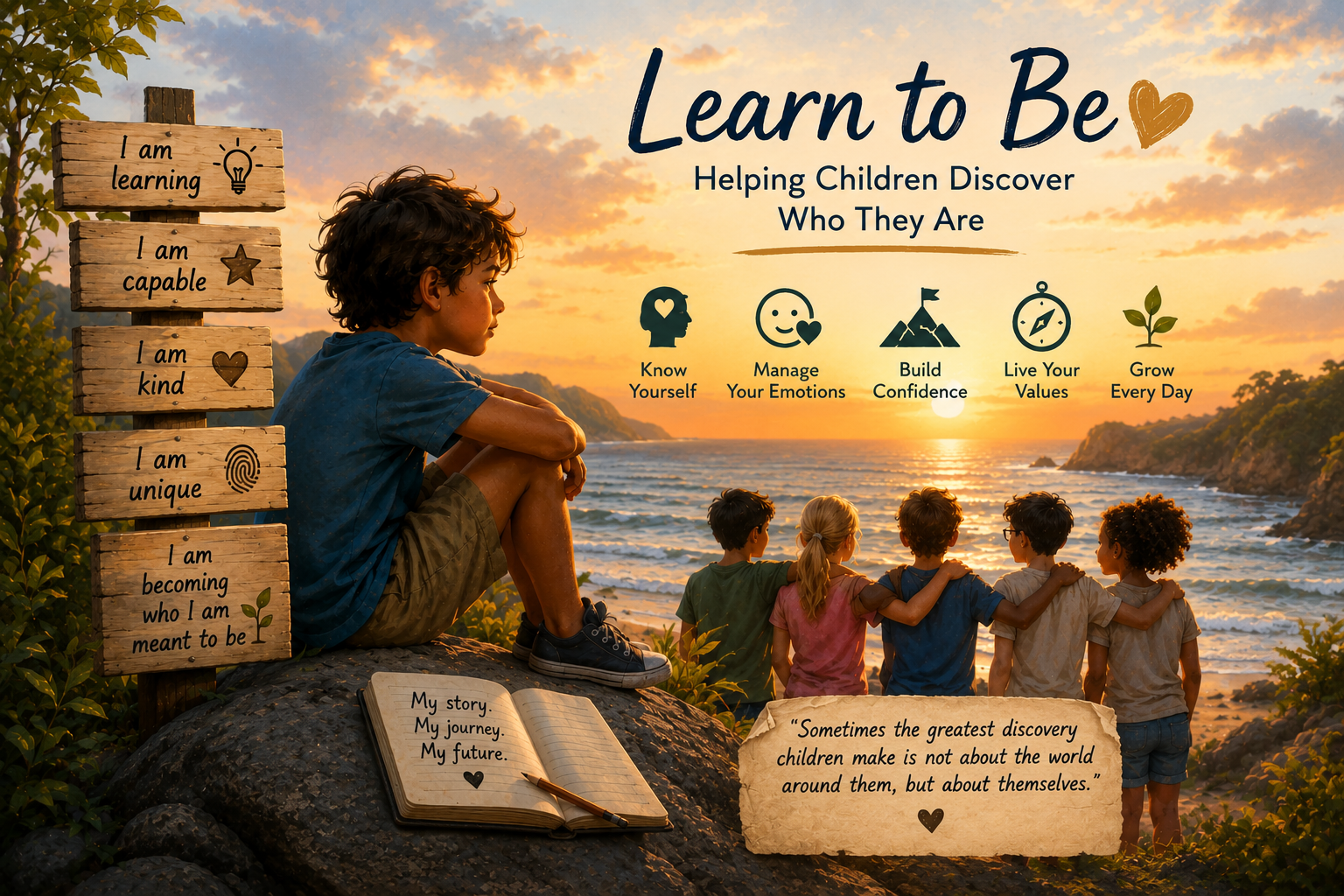

Learn to Be – Helping Children Discover Who They Are
Confidence Is Not About Being the Best
"Who am I?"
It may be one of the most important questions a child will ever learn to answer. We spend enormous amounts of time helping children discover what they can do.
Can they read? Can they calculate? Can they pass the test? Can they play the sport? Can they achieve?
But perhaps we don't spend enough time helping them discover something even more fundamental:
Who am I becoming?
This is at the heart of the fourth pillar of learning: Learn to Be. And it is also at the very heart of Emotional Intelligence.
A Child Is More Than Their Achievements
From an early age, children begin receiving messages about who they are. "You're the clever one." "She's the sporty one." "He's the quiet one." "She's the difficult one." "He's not very confident."
Sometimes these labels are intended as compliments. Sometimes they are spoken without much thought. But children listen. And gradually, what other people say about them can become what they believe about themselves.
That is why self-awareness matters so deeply.
Children need opportunities to discover that they are more than their marks, their talents, their mistakes, their appearance, or other people's opinions. They need to discover their strengths. Their values. Their emotions. Their interests. Their hopes. And yes, even the parts of themselves that are still growing.
Emotional Intelligence Begins With Knowing Yourself
We often think of Emotional Intelligence as understanding other people's emotions. But it begins much closer to home. It begins with recognising our own.
A child who can say: "I'm angry." "I'm disappointed." "I'm nervous." "I'm jealous." "I'm feeling left out." has already taken an important step. Because when children can identify what they are feeling, they can begin learning what to do with those feelings.
Instead of: I am angry, therefore I hit.
They can begin to understand: I am angry. Why am I angry? What can I do about it?
That small pause between feeling and action is enormously important. It is where self-awareness begins to grow into self-management.
And that is Emotional Intelligence in action.
Emotional Intelligence Begins With Knowing Yourself
We sometimes unintentionally teach children that confidence comes from success. Get the highest mark. Win the race. Make the team. Receive the award. Then you can feel good about yourself. But what happens when they don't win?
Real confidence is not: "I know I will succeed."
It is: "I know I can cope, learn, and keep going, even if I don't."
That is a very different kind of confidence. It gives children permission to try. To make mistakes. To change direction. To ask for help. To discover that failure is an experience, not an identity.
A child who believes "I failed at something" can grow.
A child who begins believing "I am a failure" carries a very different burden.
Our words matter.
Helping Children Find Their Own Voice
As adults, it is tempting to make children's paths easier by making decisions for them. We know more. We have experience. We can see consequences they cannot yet see.
Of course children need guidance and appropriate boundaries. But they also need opportunities to make choices.
"What do you think?" "How did that make you feel?" "What matters to you?" "What could you do differently next time?" "What do you think the right thing to do would be?"
Questions like these tell a child: Your thoughts matter. Your choices matter. You are learning to understand yourself.
Gradually, children begin developing an internal compass rather than depending entirely on the approval of others. That compass becomes increasingly important as they enter adolescence and encounter peer pressure, social media, changing friendships, expectations, and questions about where they belong.
The Comparison Trap
Today's children are growing up in a world where comparison is almost impossible to escape. They don't only compare themselves with classmates or siblings. They can compare themselves with hundreds of carefully selected images and moments every time they look at a screen. Someone seems prettier. More popular. More talented. More successful. Happier.
It can become very easy for a young person to ask: "Why am I not like them?"
This makes Learn to Be increasingly important. Children need to understand that their worth does not depend on becoming someone else.
They need adults who help them recognise:
You don't have to be the loudest person in the room to have something valuable to say. You don't have to be the best at everything to have strengths. You can make mistakes without becoming your mistakes. You can be different and still belong.
Stories Can Become Mirrors
One of the beautiful things about stories is that children often recognise themselves in characters long before they have the words to explain what they are feeling.
They see the anxious child. The child who wants to lead. The child who feels ignored. The child who loses their temper. The child who doubts themselves. And quietly they think: "That's a little bit like me."
This is one of the ideas behind Survive. Discover. Grow. – The Island Adventure. Gavin, Chloe, Freddie, Andy, and Susan arrive on the island with different personalities, strengths, fears, and ways of responding to challenges.
The island doesn't magically change who they are. Instead, the challenges force them to discover who they are. They make mistakes. They experience fear. They disagree. They need one another. They discover strengths they didn't know they possessed and weaknesses they need to work on.
And perhaps most importantly, they learn that growing does not mean becoming somebody else. It means becoming more aware of who you are, and learning how to become the best version of that person.
That is Learn to Be.
The Four Pillars Come Together
This brings us back to the four pillars we have explored throughout this series.
Learn to Know teaches children to remain curious, question, explore, and understand.
Learn to Do teaches them to apply knowledge, solve problems, make decisions, and learn through experience.
Learn to Live Together teaches empathy, respect, communication, cooperation, and belonging. And
Learn to Be helps children develop self-awareness, confidence, emotional regulation, values, resilience, and a sense of identity.
None of these pillars stands alone. Together, they help us develop the whole child.
Not simply a child who can pass an examination. But a child who can think. A child who can act. A child who can connect. And a child who knows themselves well enough to keep growing.
Preparing Children for More Than School
One day our children will leave our classrooms and our homes. We will no longer be beside them for every difficult decision. We cannot remove every disappointment. We cannot choose every friendship. We cannot prevent every mistake. And we cannot prepare them for every challenge life will bring.
But we can help them develop something that goes with them wherever they go: a strong inner foundation.
The ability to recognise what they feel. To understand what they value. To make thoughtful choices. To recover when life doesn't go according to plan. To respect themselves while respecting others. And to know that growing is a lifelong journey.
Perhaps the ultimate purpose of education is not simply to help children discover the world. Perhaps it is also to help them discover who they are within it.
That is the heart of Learn to Be. And it may be one of the greatest gifts we can give a child.
About Survive. Discover. Grow. – The Island Adventure
Survive. Discover. Grow. – The Island Adventure is a story-driven Emotional Intelligence and Life Skills adventure for children aged 9–12.
Through the experiences of five children stranded together on a remote island, young readers explore self-awareness, resilience, problem-solving, empathy, teamwork, decision-making, and personal growth.
Because sometimes the greatest discovery children make is not about the world around them. It is about themselves.
Continuing the Conversation
This article completes our exploration of the Four Pillars Every Child Needs to Thrive: Learn to Know. Learn to Do. Learn to Live Together. Learn to Be.
But our conversation about Emotional Intelligence is far from finished. In the next article in the Raising Children Who Can Thrive series, we will move from the four pillars into the everyday challenges facing children—and explore how parents and educators can turn these principles into practical skills for real life.