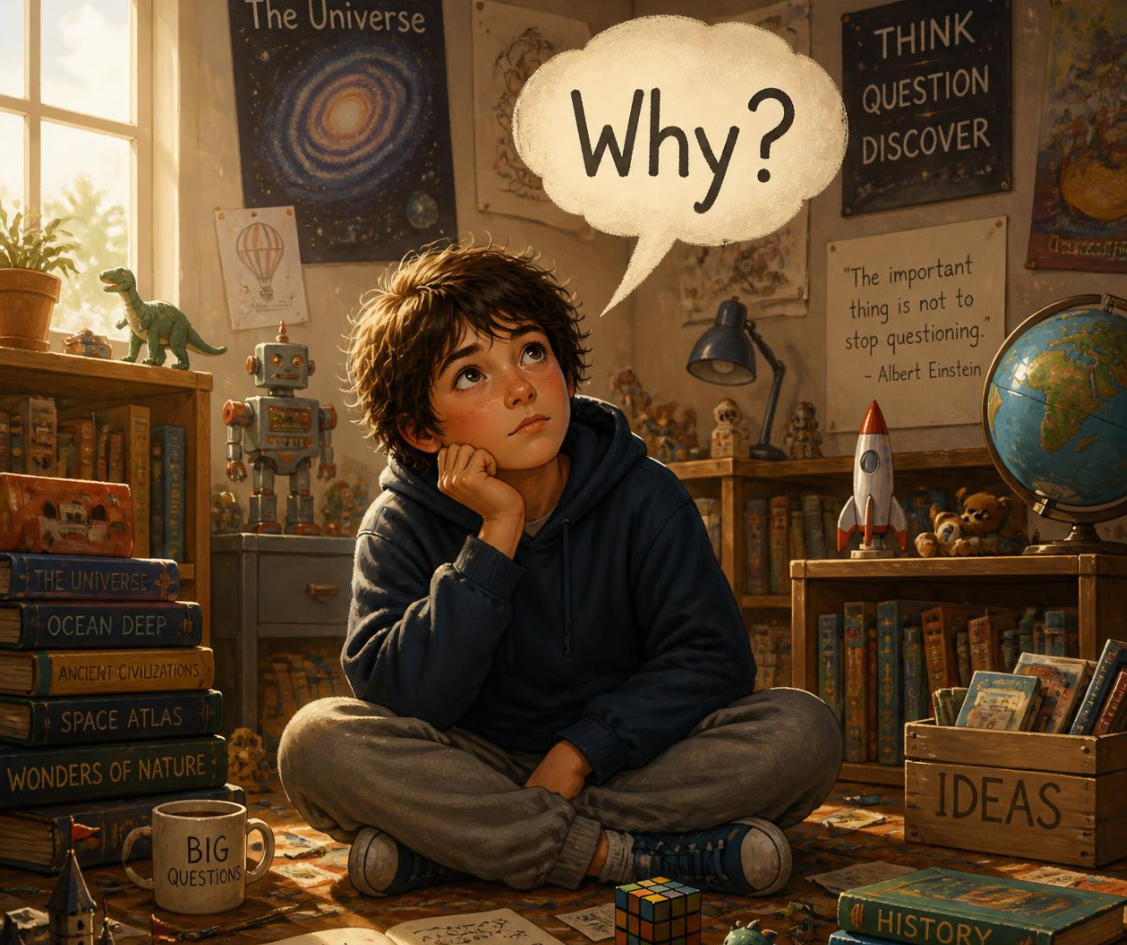

Learn to Know – Raising Curious Thinkers
"The important thing is not to stop questioning." — Albert Einstein
Have you ever noticed how young children seem to ask an endless stream of questions? "Why is the sky blue?" "Why do birds fly?" "Why do people cry?" "How do fish breathe underwater?"
To a young child, the world is one great adventure waiting to be discovered. Curiosity is natural. It is how children learn long before they ever enter a classroom.
Yet somewhere along the educational journey, something often changes. The endless "why?" questions become fewer. Instead of asking, "Why does this happen?", children begin asking, "Will this be in the test?"
As educators and parents, that should concern us.
Curiosity Is the Beginning of Learning
The first pillar of learning, Learn to Know, is far more than acquiring information. It is about developing a love of learning. It is about encouraging children to explore, question, investigate, and make connections between ideas.
Children who remain curious don't simply collect facts, they become thinkers. They don't wait to be told what to think. They learn how to think.
In today's world, where information is available in seconds, curiosity has become even more valuable than knowledge itself.
Facts can be searched. Curiosity cannot.
What Happens When Curiosity Disappears?
When curiosity fades, learning becomes a task instead of an adventure. Children begin to learn for marks instead of understanding. They become afraid of making mistakes because mistakes affect results. Instead of experimenting, they wait for someone to give them the correct answer.
Over time, learning becomes something they have to do rather than something they want to do. And that is a tremendous loss. Because curiosity fuels creativity. It drives innovation. It develops problem-solving. It encourages resilience.
It prepares children for a future where many of today's jobs do not yet exist and tomorrow's challenges cannot be solved with yesterday's answers.
How Can We Keep Curiosity Alive?
The good news is that curiosity can be nurtured every day. Parents and teachers do not need expensive resources. They simply need to create opportunities for children to wonder.
Ask open-ended questions. Encourage children to explain their thinking. Celebrate effort as much as correct answers. Allow time for exploration and discovery. Most importantly, don't rush to provide every answer.
Sometimes the greatest gift we can give a child is the opportunity to keep wondering. That is where deep learning begins.
Stories That Inspire
Thinking Stories have a unique way of awakening curiosity. Unlike worksheets or tests, a story invites children to imagine, predict, question, and discover.
Readers naturally begin asking: "What would I do?" "Why did that happen?" "Could there have been another solution?"
Those questions are the beginning of critical thinking.
That is one of the reasons my husband, Tinie, and I wrote Survive. Discover. Grow. – The Island Adventure. The story follows five young friends who unexpectedly find themselves stranded on a remote island.
There are no adults with ready-made answers. No instruction manual. No quick solutions. The children must observe, ask questions, solve problems, and make thoughtful decisions together.
As readers journey with the characters, they are encouraged to think alongside them rather than simply read about their experiences. Curiosity becomes part of the adventure.
Raising Lifelong Learners
The greatest gift we can give a child is not all the answers. It is the confidence to keep asking meaningful questions. Children who remain curious become adults who continue learning throughout their lives.
They adapt more easily. They solve problems creatively. They embrace change instead of fearing it. They never lose their sense of wonder.
That is the heart of Learn to Know.
Not filling a child's mind with information. But igniting a love of learning that lasts a lifetime. Because when curiosity grows, learning never truly ends.
Next in the Series In the next article, we explore the second pillar of learning: Learn to Do – Turning Knowledge into Action Because knowing something is important... But knowing how to apply it is where real learning begins.
Continue the Journey
SURVIVE. DISCOVER. GROW. – The Island Adventure brings these life skills to life through story. Young readers explore emotions, choices, resilience, empathy, problem-solving and relationships as they follow five children on an unforgettable island adventure.